
"I sat down at my desk and was on my phone within five minutes." "I opened the document but my brain won't move." Stop scolding yourself with willpower. Concentration is not a personality trait or talent—a large share of it is reproducible through environment design and time structure. This article sorts the reasons you can't focus into internal factors (sleep, nutrition, exercise, mental load) and external factors (sound, light, line of sight, notifications, time), and lays out concrete fixes across three timeframes: now, within 30 minutes, and starting tomorrow. Drawing on what we've learned operating Mihata's Focus Clock, the goal is reproducible answers to "I can't focus at work."
Self-Diagnosis: A "Why Can't I Focus" Checklist
Causes usually overlap, so before tackling any fix, surface your own pattern. Count how many of the ten items below apply to you.
- Got less than 6 hours of sleep last night, or woke multiple times
- Skipped breakfast, or had only a sweet pastry / sugary drink
- Drinking coffee or energy drinks past mid-afternoon
- No 30+ minute exercise session (even brisk walking) in the past week
- Phone is on the desk or otherwise in your line of sight
- Notification banners or unread Slack/email badges are constantly visible
- You unconsciously hit Cmd+Tab / Alt+Tab while working
- You have no BGM, or you're playing music with lyrics
- You sat down without articulating today's work goal
- You suddenly notice you've been working 90+ minutes nonstop
Three or more matches strongly suggests that "can't focus" is hiding in your environment and habits, not your willpower. The flip side is that fixing the environment alone tends to bring focus back. The next sections handle internal and external factors in turn.
Internal Factors: Body and Mind Are the Foundation
When people say "I want to focus but can't," they usually start by improving the external environment. But the foundation is physical condition. Review five things: sleep, blood sugar, caffeine, exercise, and mental load.
Sleep: Under 6 Hours Is Roughly Two Beers on an Attention Test
Multiple meta-analyses have repeatedly shown that chronic sleep deprivation seriously impairs cognition. Studies have suggested that two weeks of less than 6 hours per night can degrade attention-task performance to a level comparable to a full night without sleep (Van Dongen et al., 2003 and others). If you frequently feel your "focus break," start by fixing your bedtime and wake time. Weekend sleep-ins do not fully repay the debt.
Blood Sugar: A Sweet-Pastry Breakfast Steals Your Morning Focus
A meal heavy in refined carbs spikes blood sugar and triggers the reactive low that follows—drowsiness and dropping focus. Switching to a breakfast with protein and fiber (eggs, yogurt, whole-grain bread, natto) noticeably changes how productive the morning feels for many people.
Caffeine: How You Stop Matters More Than How You Start
Caffeine has a half-life of roughly 5 to 6 hours. A coffee at 3 p.m. still has nearly half its dose in your system at 11 p.m. and disturbs deep sleep. To break the loop of "can't sleep at night → can't focus next day → take more caffeine," the most effective single move is to cut caffeine after 2 p.m.
Exercise: 150 Minutes of Aerobic Exercise a Week Lifts Executive Function
The WHO-recommended 150 minutes of moderate aerobic exercise per week is supported by meta-analyses for prefrontal-cortex executive function (focus, inhibition, switching) as well as cardiovascular health. You don't need a gym membership: getting off the train one stop early, or walking 15 minutes at lunch, adds up. People who feel "ADHD-ish" with concentration tend to feel the gains from exercise especially clearly.
Mental Load: Anxiety Is the Biggest Enemy of Focus
Unprocessed tasks, next week's meeting, an awkward relationship—thoughts circling in the background occupy working memory and leave no room for focus. A GTD-style "brain dump"—writing down all your worries on paper for five minutes a day—frees up working memory.
External Factors: Sound, Light, Line of Sight, Notifications, Time
If internal factors are the foundation, external factors are the fast-acting medicine. There's a lot you can change today, and the effect is easy to feel. Most "I can't focus at work" problems improve dramatically once this layer is tuned.
Sound: "Some Noise" Beats Total Silence
Total silence often makes intrusive thoughts worse. Many people work better in libraries or coffee shops because moderate ambient noise (around 70 dB) masks distractions and stabilizes the auditory system's prediction. During work, instrumentals, Lo-fi Hip Hop, or nature sounds (rain, river, fireplace) are safer than music with lyrics, since lyrics steal language-processing resources.
Light: Use Color Temperature and Brightness to Manage Arousal
Cool light (5000–6500K) in the morning and afternoon, warmer light (2700–3500K) from evening on, follows a circadian-friendly pattern. Adding a single desk lamp raises desk-surface illuminance and pushes back drowsiness. For night-time focus work, lowering screen brightness and turning on Night Shift will protect your sleep.
Line of Sight: Phone in a Drawer; Three Items Max on the Desk
Research has suggested that a phone in your line of sight, even face-down, consumes cognitive resources (Ward et al., 2017). Putting it physically out of sight—ideally in another room or a drawer—is the strongest single fix. Keep only "PC, drink, notepad" on the desk, and visual noise drops dramatically.
Notifications: Only "Life-or-Death" Stuff Stays On
Notifications are the single biggest enemy of focus. Turn off Slack, email, social, and news, and instead actively check at fixed times (10 a.m. / 2 p.m. / 5 p.m. for example). Counterintuitively, your response time usually doesn't suffer. Use macOS Focus or Windows Do Not Disturb.
Time: 90 Minutes Nonstop Is the Brain's Limit
Even in deep work, sustained focus is generally capped at around 90 minutes. The Pomodoro technique (25 minutes work + 5 minutes break) and the DeskTime rule (52 minutes work + 17 minutes break) work because simply chunking time raises focus in a reproducible way. The break also makes "let me push 10 more minutes" easier psychologically.
By Timeframe: Now, Within 30 Minutes, Starting Tomorrow
Even when you can name the cause, choosing where to start is hard. Here is a three-tier action plan, prioritized.
5-Minute Fixes You Can Run Right Now
- Move your phone to another room or a drawer (out of sight)
- Turn off all PC notifications (Focus mode / Do Not Disturb)
- Drink a glass of water (mild dehydration alone hurts focus)
- Open the window and take 10 deep breaths (CO2 over 1000 ppm impairs cognition)
- Write one line on paper: what you'll do in the next 25 minutes
All five fit inside five minutes and show effects immediately. The last item—writing one sentence on what to do for the next 25 minutes—pairs especially well with Pomodoro because the goal is now explicit.
30-Minute Environmental Fixes
- Trim the desk to "PC, drink, notepad"
- Have earphones or headphones ready with work BGM cued up
- Turn on the desk lamp; raise desk-surface brightness
- Close all unneeded browser tabs (Cmd+Option+W)
- Adjust chair height and monitor position (eyes slightly above the screen)
Environmental fixes pay back every day after, so they are high-ROI. The trick with BGM is to spend almost no time choosing it. Opening playlist after playlist itself breaks focus, so use a service that just plays the right thing.
Habit-Level Changes Starting Tomorrow
- Fix bedtime and wake time (within ±1 hour even on weekends)
- Stop caffeine after 2 p.m.
- Add protein to breakfast
- Walk a total of 30 minutes between commute and lunch
- Before bed, write down three tasks for tomorrow
Habits don't survive on willpower; they survive on fewer decisions. Starting work at the same time, in the same place, with the same BGM trains your brain to read it as a "focus switch," and the time from sitting down to focused state shortens.
Tuning the External Environment in One Window: The Focus Clock
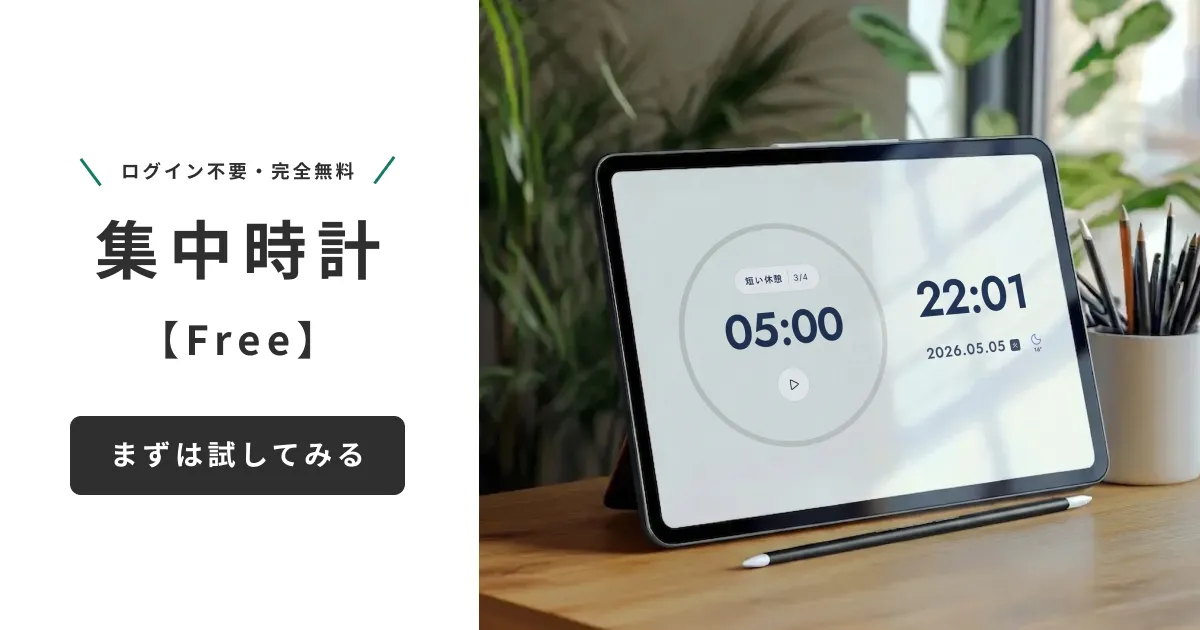
Of the external factors above—sound, light, line of sight, notifications, time—software can handle a meaningful subset together. That is exactly the combination of BGM, fullscreen, timer, and notification suppression that browser-based focus clocks bundle.
Why Pack "Clock + Timer + BGM" Into One Screen
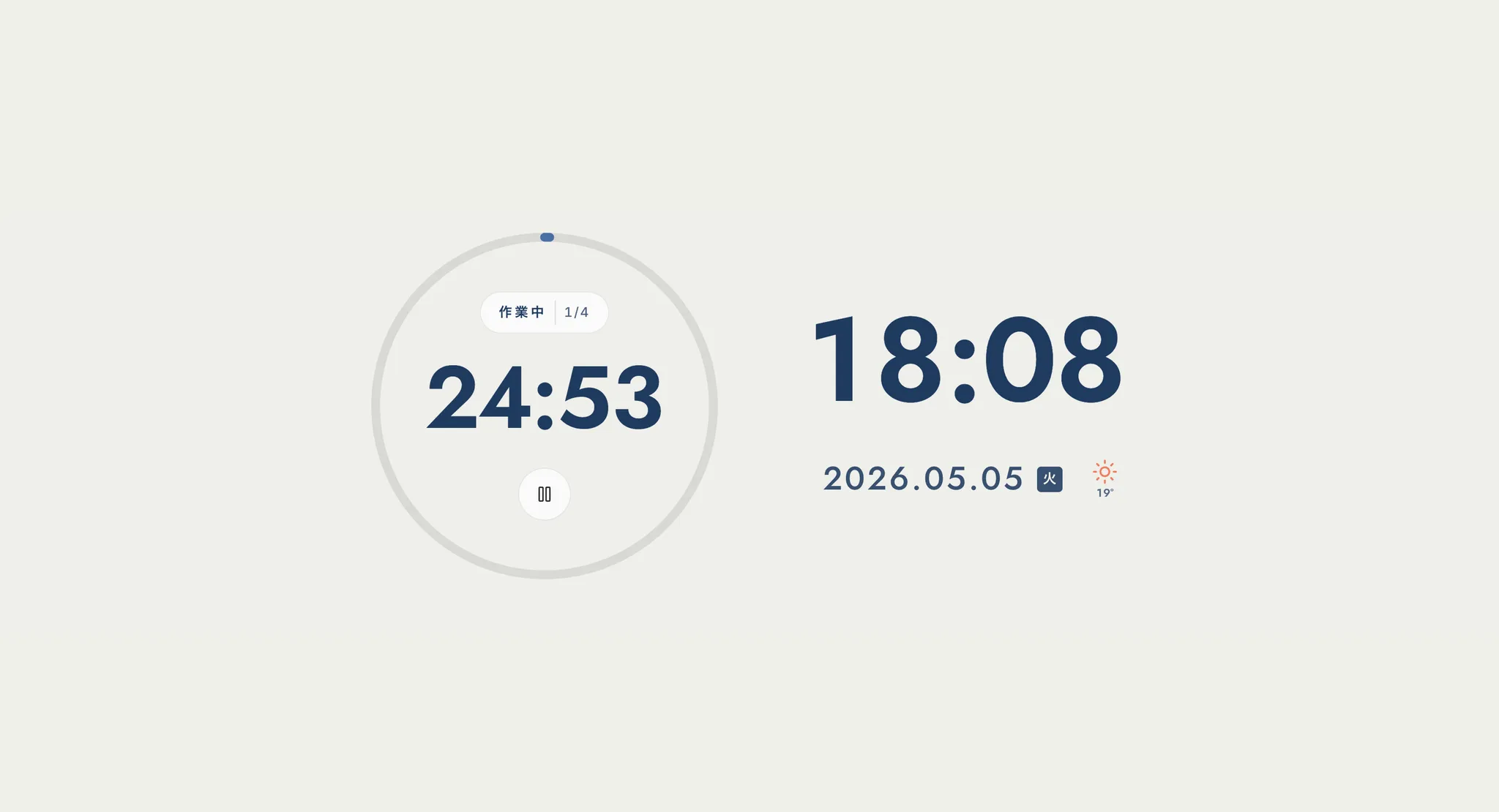
Music in Spotify, timer in another app, clock in the menu bar—every switch costs mouse trips and broken focus. Putting them on one screen lets you reach a state where opening the browser and going fullscreen IS the focus prep.
What Mihata's Focus Clock Includes
- Pomodoro timer (25 min focus + 5 min break, kept running across tab switches via a Web Worker)
- Work BGM presets (Lo-fi, nature sounds, café ambience)
- Stylish background presets and font switching
- Fullscreen view to reset visual noise
- PWA support, launchable from your home screen
- Fully free; no install, no ads, no login
Settings are saved in local storage, so you don't reconfigure every time—"open it and you're already in focus mode."
A Concrete Workflow
- Open Focus Clock in your browser (or via the home-screen icon if installed as a PWA)
- Pick a BGM preset, set the volume low
- Decide background and font once, then leave them alone
- Start a Pomodoro; do not switch tabs for 25 minutes
- During the 5-minute break, stand up and look out the window
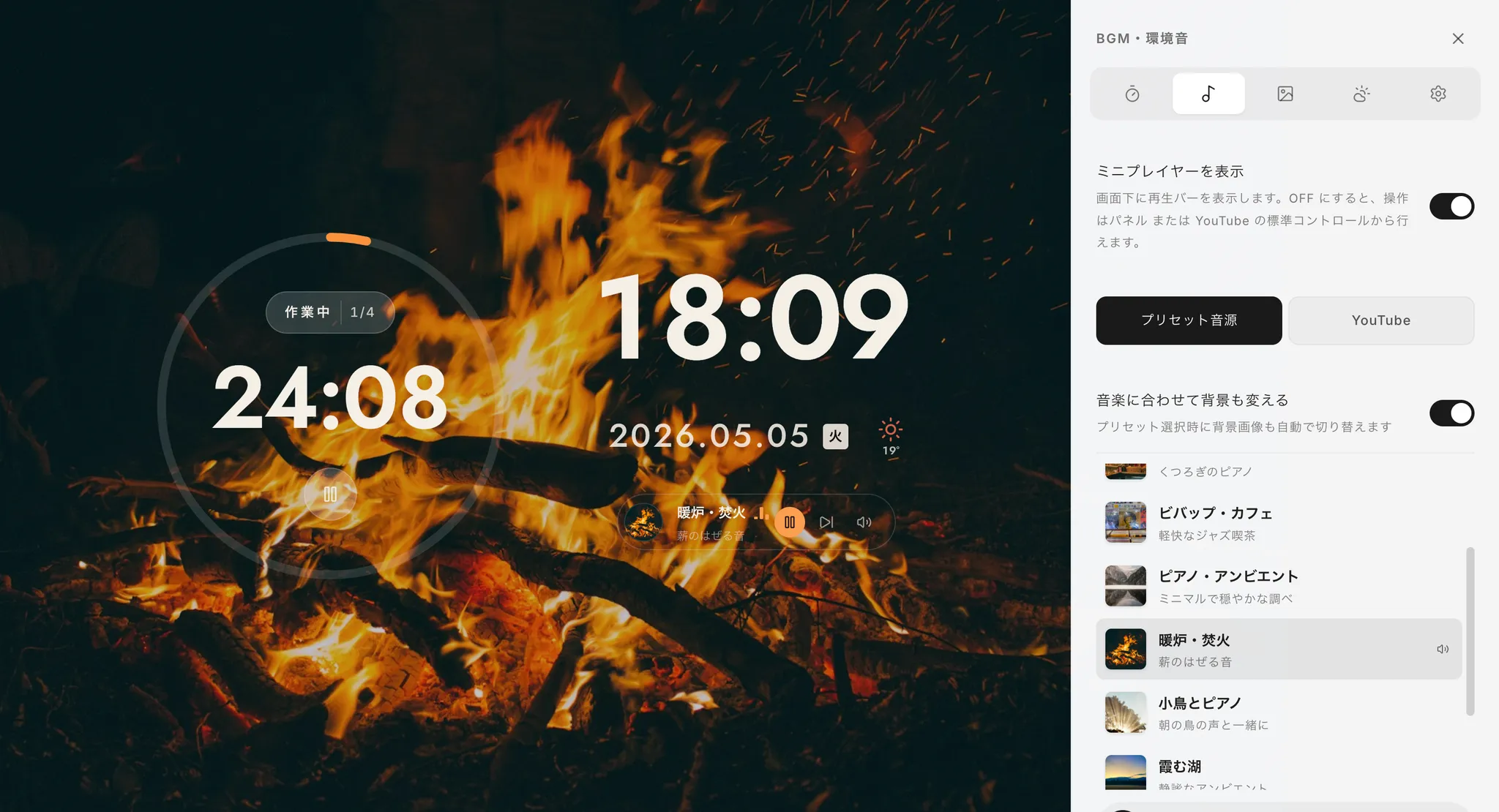
Because this flow handles internal factors (eye strain, sitting too long) and external factors (time structure, BGM, visual noise) at the same time, even four sets a day (about two hours) noticeably changes how focused the day feels.
A Note for People Who Feel "ADHD-ish"
Formal diagnosis is for medical professionals, but if "I want to focus but can't," "I procrastinate badly," or "I keep starting other things mid-task" sounds familiar, this group benefits especially from external environment design. Four points to keep in mind.
Make Time Visible
For people with weak time perception, keeping a large clock and a countdown always in view works well. With an analog clock or a visual timer, remaining time is shown as area, which makes "almost done" intuitive.
Cut Tasks Smaller
Don't write "create the deck"—write "write the title," "draft three lines of TOC." Aim for one sub-task per Pomodoro. A continuous string of small wins keeps motivation (and dopamine) flowing.
See a Doctor If Needed
If six months of these tactics produce no improvement, or daily life is impaired, don't self-diagnose—consult a psychiatrist or mental-health clinic. A formal diagnosis and proper treatment work better in parallel with environment design, not as a replacement for it.
Summary: Focus Is Built, Not Squeezed Out
Concentration is not something you grit out of yourself; it's a state that emerges from how you've designed environment and time. The key takeaways:
- Split causes into internal (sleep, blood sugar, caffeine, exercise, mental load) and external (sound, light, line of sight, notifications, time)
- Run fixes in three tiers: right now (5 min), within 30 minutes, and starting tomorrow
- Software can tune the external layer in one place, and that's where reproducibility comes from
- Bundling BGM, timer, and a fullscreen clock makes "open it = focus starts"
- People who feel "ADHD-ish" benefit even more from environment design
Today, put your phone in a drawer, silence PC notifications, open Focus Clock in your browser, and run one Pomodoro. Fixing your concentration can start with a single 25-minute block.
If you'd like to know why we built Focus Clock and the philosophy behind its features, see the development story in Mihata's own words.